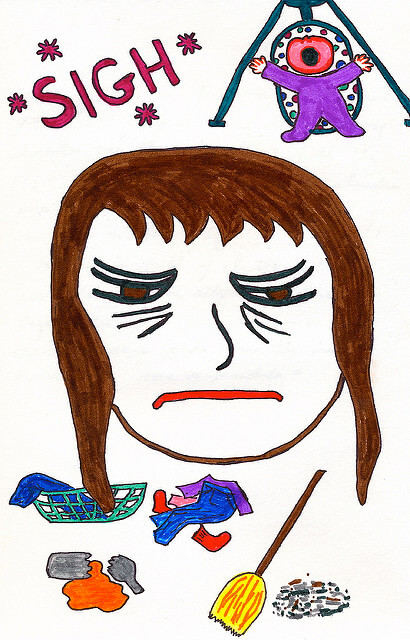
Home schooling, the new parental chore brought about by coronavirus lockdowns, is being handled disproportionately by women, according to a new poll by Morning Consult for The New York Times. Fathers don’t necessarily agree — nearly half of those with children under 12 report spending more time on it than their spouse — but just 3 percent of women say their spouse is doing more. Eighty percent of mothers say they spend more time on it.
The Impact of COVID-19 on Gender Equality
The economic downturn caused by the current COVID-19 outbreak has substantial implications for gender equality, both during the downturn and the subsequent recovery. Compared to “regular” recessions, which affect men’s employment more severely than women’s employment, the employment drop related to social distancing measures has a large impact on sectors with high female employment shares. In addition, closures of schools and daycare centers have massively increased child care needs, which has a particularly large impact on working mothers. The effects of the crisis on working mothers are likely to be persistent, due to high returns to experience in the labor market. Beyond the immediate crisis, there are opposing forces which may ultimately promote gender equality in the labor market. First, businesses are rapidly adopting flexible work arrangements, which are likely to persist. Second, there are also many fathers who now have to take primary responsibility for child care, which may erode social norms that currently lead to a lopsided distribution of the division of labor in house work and child care.
Hollywood working moms and the brutal conflict between family and career
Nearly every mother in Hollywood has a horror story.
There was the time screenwriter and showrunner Aline Brosh McKenna was 8½ months pregnant and a studio executive joked, “I guess today would be a bad day to punch you in the stomach.” There was the time Nisha Ganatra, director of the upcoming Mindy Kaling film “Late Night,” went on a scouting trip to India when she was a new mom and found herself driving around the country in a van “with 15 dudes,” pumping breast milk in “a woodshed in the middle of a desert and an outhouse behind a restaurant.” There was the time a dream job offer fell through for Oscar-nominated “Mudbound” cinematographer Rachel Morrison because producers panicked that she’d be going back to work a few weeks after giving birth — something she was willing to do to help realize one of the most exciting scripts she had ever read. The experience, she says, “made me acutely aware of the prejudices in this industry, specifically in my line of work.”
Read this before you have a baby (especially if you’re a woman)
It seems so obvious: having kids affects men and women differently. Sure, emotionally and financially but most clearly in the simple way mothers and fathers spend their time. And when you actually look at how 10,900 Americans carve up 24 hours, the conclusion is pretty stark: if you’re a woman who enjoys paid work or relaxing activities, having kids will cramp your style. Being married with kids also isn’t looking like a great idea according to the numbers.
Boot Camp for New Dads
Boot Camp for New Dads® (aka Daddy Boot Camp®) is a unique father-to-father, community-based workshop that inspires and equips men of different economic levels, ages and cultures to become confidently engaged with their infants, support their mates and personally navigate their transformation into dads.
Mapping Gender: Shedding Empirical Light on Family Courts’ Treatment of Cases Involving Abuse and Alienation
This article provides a brief literature survey, focusing on the theory of “parental alienation” which operates as a primary vehicle for making abuse invisible in custody litigation. This Article reports on the co-authors’ pilot study, which begins empirically mapping family courts’ uses of this theory. These pilot results provide preliminary empirical support for the critiques from the field.
Millennial Men Aren’t the Dads They Thought They’d Be
The New York Times July 30, 2015 By Claire Cain Miller Young men today have aspirations of being hands-on fathers as well as breadwinners — supportive husbands who also do dishes. But as they enter that more responsibility-filled stage of life, something changes: Their roles often become much more traditional. Millennial men — ages 18 to early 30s — have …
Good Night Stories for Rebel Girls
“Good Night Stories for Rebel Girls” is a children’s book packed with 100 bedtime stories about the life of 100 extraordinary women from the past and the present, illustrated by 60 female artists from all over the world. Each woman’s story is written in the style of a fairy tale. Each story has a full-page, full-color portrait that captures the …
As More New Dads Get Paternity Leave, Companies Push Them to Take It
As more companies offer new fathers more paid time off, a new challenge has emerged—persuading working dads to actually take advantage of it.
At some companies, new fathers get advice from older colleagues to take their full paid leave; ‘If you don’t take it, it’s borderline idiotic,’ one manager said
Will millennial men keep their wives from career success?
Fortune November 18, 2014 By Ben Geier There’s a disconnect, it seems, in a lot of young American families. Just who is going to take care of the kids? According to a recent study by the Harvard Business Review, 66% of millennial men expect their partner to take the primary responsibility for raising children. On the other hand, only 42% …